

What is a Fluorocarbon advance?
We often hear about fluorocarbon leaders , hooklengths, or snoods, and for good reason. This type of fishing line possesses unique and incredible properties, offering anglers possibilities they could only dream of before it came onto the market.
It actually appeared over 50 years ago, more precisely in 1972 at the Osaka trade fair. It was marketed by the Kureha company under the Seaguar brand. For those who are particularly meticulous, its real name is polyvinylidene fluoride, a thermoplastic fluoropolymer.
Unique characteristics
Before deciding whether or not to use a spearhead made of this material, one must first know its main characteristics.
- Refractive index of 1.4 (water has an index of 1.33)
- Very low elasticity.
- Good abrasion resistance.
- High density, between 1.77 and 1.81, which makes it sink faster than nylon for example.
The density of fluorocarbon allows it to sink quickly, but that's certainly not the reason for its popularity. Its refractive index of 1.4 is very close to that of water, which is 1.33, making it practically invisible to the eye of a fish. Add to that its very low stretch and good abrasion resistance, and you have the perfect leader. What's more, it's relatively affordable. Who wouldn't be willing to spend a few extra cents on their line to improve their chances of catching fish?
Types of fluorocarbon thread
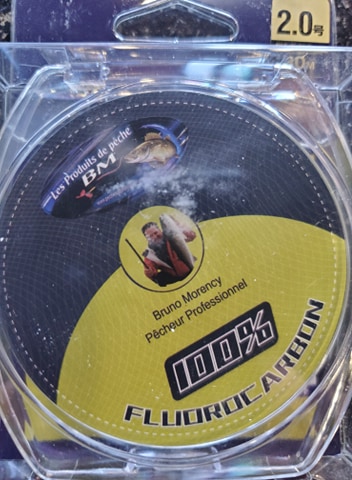
100% Fluorocarbon: Thread which in the vast majority of cases is intended to serve as a leader, although certain variants can sometimes be used directly in the reel.
Fluoro-coated line : This line is much easier to cast and use directly on the reel. It's often nylon line coated with fluorocarbon, meaning it has a nylon core, which unfortunately tends to degrade more or less quickly. It should be considered and used as a reinforced nylon line. This type of line isn't a very good option for use as a leader.
Hybrids: These are types of fishing lines that have characteristics more or less similar to those of 100% fluorocarbon. They are made of several materials bonded together in a single strand. The manufacturer often indicates the possible uses of this type of fishing line on the packaging.
Fish can see your braided line
It's true, fish can see your braided line very well. Some species will be much more susceptible to this than others. Muskies and pike, for example, won't hesitate to strike a fishing lure attached to a steel or titanium leader, which is extremely strong and highly visible. This is actually a very good thing, because the teeth of these two predators are absolutely formidable and can instantly sever your braided line or monofilament nylon. Even fluorocarbon rarely withstands multiple attacks from these predators.
A salmonid that manages to spot your fishing line often means a very bad day of fishing. Salmon and trout of all kinds are extremely sensitive to the sight of your line. The slightest hint and it's all over for you. Fishing for salmonids with a braided line without a leader will most likely produce disastrous results every time.
Nylon line can be an alternative to braided line for smaller, more delicate species, but nylon has the disadvantage of being very stretchy, offering a lower quality hookset and not resisting abrasion well.
Depending on weather conditions, water clarity, and fish abundance, most species will react to the sight of your fishing line, some more than others. Largemouth bass will likely ignore it, while walleye, being more wary, will probably pass you by if you fish for them in clear water.
When should a fluorocarbon leader be used?
In our opinion, whenever you fish with braided line or other highly visible types of line, the tip is the part most susceptible to wear from abrasion against rocks. A fluorocarbon leader will better protect against this, thus reducing the risk of losing a trophy fish when setting the hook with a damaged line.
While some species will take your lure on braided line, our team unanimously agrees that, on average, we get better results with a fluorocarbon leader. It only costs a few cents and a few seconds of our time to add to your line, so why not? Who would really want to risk a bad day of fishing just to bet on whether the fish can see their line or not? In our many days fishing for striped bass, an aggressive predator, we've had far better results with a leader.
When fish become scarcer and in the days following a cold front, and especially when finesse fishing is more challenging, you can't leave anything to chance. You fish with your best lures, using the most effective colors and the most effective exposure. Above all, don't let the fish see your fishing line.
The length of your bow
What is the minimum or maximum length your leader should be? Like many questions in the fishing world, the answer is simply: it depends. As a general rule, we recommend a leader of 12 to 24 inches. These lengths will suit most of the species you typically target. You'll also have the option of cutting your line a few times to change lures, although this need can be practically eliminated with the use of Duo Lock Snaps by BM Fishing Products.
Finally, be aware that for some species you might need to use 10 feet or more of leader. During our tuna fishing trips, Captain Jimmy Lepage used over 100 feet of 300lb test leader.
How to attach your fluorocarbon leader
Several options exist for securely tying two lines together without losing too much strength at the knot. The most commonly used knot for this purpose is the uni-to -uni knot. The more you pull on the lines in opposite directions, the tighter the two knots become, making it the perfect knot for joining two lines.
Here's how to attach your braided line to your fluorocarbon leader.

In conclusion
There are many advantages to using a fluorocarbon leader and very few disadvantages, so why not use it? The cost is minimal, and the quality of your fishing will be greatly improved. Fluorocarbon offers superb hooksets, adds protection to your line, and, most importantly, makes your fishing line virtually invisible to the fish.
If you have any questions on the subject or simply want more advice on using fluorocarbon leader, then feel free to contact our team in the comment section of this article, through our company Facebook page, or directly on the contact page of our website .